AI-Powered Cyberattacks Are Here — Here Is How Nigerian Businesses Can Respond
Cybercriminals across the world have picked up a new tool: artificial intelligence. They are using it to write more convincing phishing emails, build malware that changes its code to evade detection, and automate attacks at a scale that was previously impossible. For Nigerian businesses, this is not a distant problem.
Deloitte Nigeria’s Cybersecurity Outlook 2025 states plainly that the “race between AI-powered cyberattacks and AI-driven defence is expected to intensify,” and that Nigerian organisations must treat AI not merely as a defensive tool but as core to their security strategy. The CYFIRMA threat assessment on Nigeria found that in 2025 alone, banking databases, telecom records, and government data were sold on dark web forums. Some listings included over 60 million Nigerian phone records.

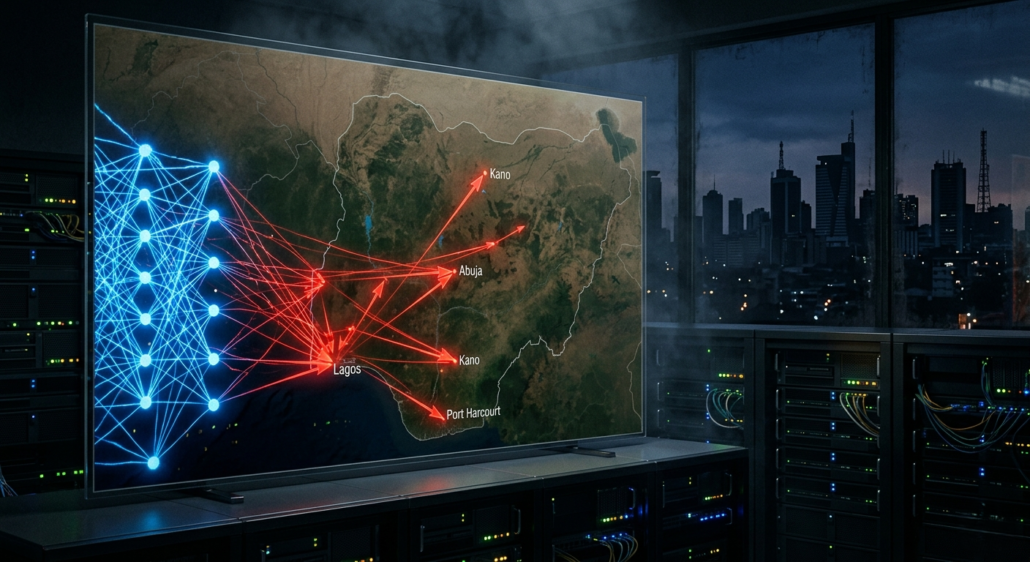
Cybersecurity analysts in Nigeria face a rapidly evolving AI threat landscape. Image: DST
What AI-Powered Attacks Actually Look Like
Polymorphic malware rewrites its own code each time it spreads, making traditional signature-based antivirus tools largely useless. Nigerian IT teams that rely on free or outdated antivirus software face the greatest exposure.
AI-generated phishing now produces emails and SMS messages indistinguishable from authentic bank communications. The days of spotting a scam by its typos are largely over. As ngCERT (Nigeria’s Computer Emergency Response Team) has documented, phishing campaigns within Nigeria’s cyber ecosystem have increased sharply. Read more: Beware the Bengal Cat: A Sinister Search Term.
Deepfakes are being used in audio and video to impersonate executives during financial transactions. A tactic increasingly documented in West African corporate environments.
The Scale of the Problem
Nigeria’s cybersecurity market was valued at $230 million in 2025 and is projected to reach $414 million by 2031, growing at 10.32% annually (Mordor Intelligence, January 2026). The National Information Technology Development Agency (NITDA) estimates Nigeria loses over $500 million annually to cybercrime.
African organisations suffer a significantly higher rate of attacks compared to global averages. Check Point Software’s research shows Africa is frequently used as a testing ground for new attack methods before they are deployed elsewhere.
Practical Steps for Nigerian Businesses
- Move beyond passwords. Implement multi-factor authentication (MFA) on all systems, especially for financial and administrative accounts.
- Train your employees. IBM research consistently shows that over 95% of cyberattacks involve human error. Related: New Employees Can Be a Cybersecurity Risk.
- Move to cloud-native security. Cloud-delivered security controls now represent 57.2% of cybersecurity spending in Nigeria, growing at 20.4% annually.
- Implement zero-trust architecture. Zero trust means no user or device is trusted by default — access is verified continuously.
- Choose your hosting carefully. A host with DDoS protection, automatic backups, and a Web Application Firewall reduces your attack surface. Read: Don’t Let Bad Hosting Sink Your Website.
Where to Report Incidents
- ngCERT (cert.gov.ng) — Nigeria’s national response team
- NITDA (nitda.gov.ng) — for data breaches under the Nigeria Data Protection Act
- EFCC — for financial fraud related to the breach






Leave a Reply
Want to join the discussion?Feel free to contribute!