Tag Archive for: Google

When Your Customer Asks an AI Instead of Google: What Nigerian Businesses Should Actually Do in 2026

If your website’s organic traffic fell between 2024 and 2026 and you cannot find the competitor who took it, there may not be one. A structural change in how search results are presented has removed a large share of clicks from the web entirely. The visits did not move. They stopped happening.

This has produced two bad responses among Nigerian businesses. The first is to ignore it, on the reasonable-sounding basis that Nigerian customers still search normally. The second is to buy an expensive package of AI optimisation services from a vendor whose methods nobody can verify. Both are mistakes, and the evidence published over the last eighteen months is now good enough to say why.

How large is the change, really?

The most methodologically careful measurement comes from the Pew Research Center, which tracked the actual browsing behaviour of a panel across roughly 68,000 real Google searches. It found that users clicked an external link on 8 per cent of searches where an AI summary appeared, against 15 per cent where none did. Sessions ended entirely on 26 per cent of pages carrying an AI summary, against 16 per cent otherwise.

Other measurements point the same way with different magnitudes:

  • A randomised field experiment reported in April 2026 found AI Overviews reduced organic clicks on triggered queries by about 38 per cent, while self-reported satisfaction with search was essentially unchanged. Removing top-of-page AI Overviews roughly doubled outbound clicks.
  • Ahrefs, analysing Search Console data, reported click-through rate falling by around 58 per cent for top-ranking pages when an AI Overview appeared. Seer Interactive measured a comparable 61 per cent drop across billions of impressions.
  • BrightEdge put AI Overview trigger rates at roughly 48 per cent of tracked queries by early 2026, up sharply year on year. SparkToro’s clickstream analysis for January to April 2026 put the overall zero-click rate near 68 per cent.
  • Google announced at its 2026 developer conference that AI Mode, its fully generative interface, had passed a billion monthly users. Independent clickstream data over the same window put AI Mode at only about 0.34 per cent of searches, which suggests the larger disruption has not arrived yet.

These studies use different panels, query sets and methods, and their estimates range from mild to severe. Treat any single figure with caution. The direction, though, is consistent across every independent measurement published, which is more than can be said for most claims in this field.

One finding deserves separate emphasis because it changes the strategy. Seer Interactive found that brands cited inside an AI Overview received roughly 35 per cent more organic clicks and 91 per cent more paid clicks than uncited brands appearing on the same results page. The market is not shrinking uniformly. It is splitting into cited and bypassed, and the gap between those two states is now larger than the gap between position one and position five used to be.

Does this land the same way in Nigeria?

Partly. Nigeria had roughly 109 million internet users at the end of 2025, an online penetration of about 45.5 per cent, against 165 million active cellular connections. The NCC put active internet subscriptions at 142.6 million as of October 2025. This is an overwhelmingly mobile market, and roughly four in five AI Overview queries globally occur on mobile, so Nigerian users are squarely inside the affected population.

But the exposure is uneven, and the distinction matters for where you spend.

Local transactional queries are relatively protected. Someone searching for a solar installer in Lekki, a diagnostic centre in Wuse or a school fees portal needs an address, a phone number or a login. The answer is a destination, not a summary. These queries still produce clicks, and for most Nigerian SMEs they are the commercially important ones.

Informational and comparison content is heavily exposed. Guides, definitions, how-to articles and product comparisons are exactly what generative answers are best at absorbing. If your traffic strategy was built on ranking for questions, that strategy has been substantially devalued.

There is a Nigerian opening that few are taking. Generative systems answering questions about Nigeria are drawing on a thin, often outdated and frequently foreign-authored source base. Ask an assistant about Nigerian regulatory deadlines, local pricing or sector-specific practice and the answers are noticeably weaker than the equivalent for the United States or United Kingdom. That gap is an opportunity for any Nigerian organisation willing to publish primary, dated, verifiable local information. It is easier to become a cited source on a Nigerian topic today than it will be in three years.

What does the evidence say does not work?

This is the part of the discussion where most money is currently wasted. On 15 May 2026 Google published its first official guidance on optimising for generative features in Search. Its position is blunt: these features run on the same core index and ranking systems as ordinary Search, so optimising for them is still SEO. The guidance then names specific tactics site owners can stop worrying about.

  • txt and similar machine-readable files. Google states plainly that it does not use them. Google may crawl such a file, but it receives no special treatment.
  • Chunking content into small blocks for machine consumption. Google says its systems handle multiple topics on a page and surface the relevant part.
  • Rewriting content into an AI-friendly voice. The systems understand synonyms and meaning.
  • Special schema markup for AI features. Not required.

Independent testing points the same way. An Ahrefs study published in May 2026 measured AI citations across 1,885 pages against a control group of about 4,000, before and after adding schema markup, and found no citation lift — with a small decline on Google’s AI Overviews. The caveat matters: the tested pages already had strong citation baselines, so the result speaks most directly to brands with existing AI visibility. Separately, an analysis of roughly 500 million AI bot visits over ninety days recorded only a few hundred actual fetches of llms.txt files, with adoption across domains flat at around 10 per cent.

The honest reading is narrower than either camp claims. Schema markup remains worth implementing, because it drives rich results in conventional search and costs little. It is simply not an AI visibility lever, and should not be sold as one. An llms.txt file costs nothing to publish and may serve systems other than Google, so publish it if you like. Do not pay a consultant for it.

What does the evidence say does work?

The strongest evidence in this field is a peer-reviewed paper presented at ACM KDD in 2024 by researchers from Princeton, Georgia Tech, the Allen Institute and IIT Delhi, which tested content interventions across thousands of queries and several generative engines. It found that restructuring content to include cited sources, direct quotations from authorities and concrete statistics produced visibility gains in generated answers in the range of 30 to 115 per cent. Two interventions that the marketing industry sells heavily did nothing: rewriting purely for fluency produced almost no lift, and keyword stuffing produced a small negative effect on some engines.

Two qualifications from the same research are usually omitted when it is cited. The same intervention can help substantially on one engine and barely register on another, because retrieval and ranking models differ. And the gains, while real, are bounded — no strategy doubled citation rates across the board. This is a discipline of small compounding wins, not a lever.

That leaves a short list of things worth doing, all of which happen to also be good writing:

  1. Answer the question in the first sentence of each section, then give the context. A passage that only makes sense after three paragraphs of preamble cannot be extracted.
  2. Make sections self-contained. If a paragraph relies on a pronoun referring to something two screens above it, it will be retrieved without its meaning.
  3. Attribute every statistic to a named source with a date. This is the single most consistent finding across the research, and it is also the thing most Nigerian business blogs do least.
  4. Shape headings as the questions your customers actually ask, in their words, not your internal product vocabulary.
  5. Keep facts current and date-stamp updates. Generative systems favour recency, and stale figures are the fastest route to being dropped from a cited source pool.
  6. Keep entity information identical everywhere: business name, address, phone number, description. Across your site, your Google Business Profile, your directory listings and your social profiles. Inconsistency here is why assistants describe businesses inaccurately.
  7. Publish something nobody else has. Original data, your own operational numbers, a survey of your customers, a price index for your sector. Google’s own guidance now leans explicitly on content that is not a commodity restatement of what is already online.

The technical floor

None of the above matters if the systems cannot read your pages. Check these first, because they are cheap, verifiable and frequently broken on Nigerian websites:

  • Your robots.txt does not block the crawlers you want citing you, and your CDN or web application firewall is not silently rejecting their requests.
  • Important content is rendered server-side, not assembled by JavaScript after the page loads.
  • Nothing commercially important sits behind a login, a pop-up or an interaction that a crawler cannot complete.
  • Heading hierarchy is real: one H1, meaningful H2s, no headings used purely for visual size.
  • Your pages load fast enough to be crawled efficiently, which on a Nigerian-hosted or Nigerian-audience site usually means fixing hosting and image weight before anything else.
  • Google Search Console is connected, so you can use its generative AI performance report rather than guessing.

How do you measure this without buying a dashboard?

Measurement in this field is genuinely poor, and a large part of the vendor market exists to sell certainty that does not exist. A workable free approach:

  • Use the generative AI performance report in Search Console for Google surfaces.
  • Segment referral traffic from assistant domains in your analytics. Volumes will be small; the conversion quality is usually high, because someone who clicks out of an AI answer is deep in an evaluation.
  • Watch branded search volume and direct traffic. If you are being described accurately in AI answers without a link, these are where the effect surfaces.
  • Keep a fixed panel of twenty prompts a real customer might ask, and run them monthly across the major assistants. Log whether you appear, whether the description is accurate, and who appears instead. This is crude, manual and more informative than most paid tools.

The case for doing much less than the industry recommends

An honest article should make the opposing argument properly, so here it is.

For most Nigerian SMEs, absolute AI referral volume is still small. Conventional Google organic search, WhatsApp, Instagram and word of mouth remain far larger sources of business, and a naira spent improving conversion on the traffic you already have will usually beat a naira spent chasing citations. The generative optimisation services market is growing at rates that should make any buyer suspicious, and much of what it sells is unfalsifiable by design. Google’s own position is that this is ordinary SEO, which implies a business with slow hosting, thin content and no Google Business Profile should fix those first and ignore the acronyms entirely.

There is also a reasonable argument that the trend is being over-extrapolated. Independent clickstream data showed the United States zero-click rate falling slightly between December 2025 and March 2026 on a strict methodology, and AI Mode remains a rounding error in query share. People predicting the end of the web have been wrong before.

Weighing it up: the defensible position is that AI visibility should be a by-product of publishing genuinely useful, original, well-sourced, crawlable content, not a separate budget line with its own vendor. Everything on the evidence-backed list above improves your conventional search performance too. That is the test to apply to any proposal you receive. If a tactic only helps if the AI thesis is correct, it is a bet. If it helps either way, it is a decision.

The bottom line

The measured decline in clicks is real, substantial and unlikely to reverse. The market is separating into sources that get cited and sources that get bypassed, and the citation premium is large. But almost none of the tactics being sold to close that gap survive contact with evidence, and the search engine at the centre of it has now said so in writing.

What survives is unglamorous: be crawlable, be structured, be specific, be current, be attributable, and publish something about Nigeria that nobody else has published. That was good advice in 2019. It is now the only advice with data behind it.

Statistics in this article were current as of July 2026. This field changes monthly; verify before relying on any figure.


Sources

Google Search Central, optimising for generative AI features in Google Search;  Search Engine Journal, Google’s AI search guide calls AEO and GEO still SEO; Search Engine Journal, randomised field study on AI Overviews and organic clicks; Search Engine Land, Google zero-click searches in early 2026; Similarweb, zero-click marketing and the 2026 data;

Refinea, operational review of generative engine optimisation evidence including the Ahrefs schema study; We The Flywheel, review of the ACM KDD 2024 generative engine optimisation paper; DataReportal, Digital 2026: Nigeria; AllAfrica, NCC data on active internet subscriptions in Nigeria

A way to access Google accounts without a password by Hackers

A recent discovery by security researchers has unveiled a new hacking technique that enables cyber criminals to infiltrate individuals’ Google accounts without requiring their passwords. CloudSEK, a security firm, conducted an analysis and identified a malicious form of malware that exploits third-party cookies to gain unauthorized access to users’ private data. This dangerous exploit is already being actively tested by various hacking groups.

The revelation of this exploit occurred in October 2023 when a hacker shared information about it on a Telegram channel. The hacker explained how accounts could be compromised through a vulnerability associated with cookies. Cookies are utilized by websites and browsers to track users and enhance their browsing experience.

Google authentication cookies play a crucial role in allowing users to access their accounts without repeatedly entering their login credentials. However, the hackers have discovered a method to retrieve these cookies, thereby bypassing the security measures of two-factor authentication.

To address this issue, Google Chrome, the world’s most widely used web browser with a market share exceeding 60% last year, is currently taking steps to crack down on third-party cookies.

“We routinely upgrade our defences against such techniques and to secure users who fall victim to malware. In this instance, Google has taken action to secure any compromised accounts detected,” Google said in a statement.

“Users should continually take steps to remove any malware from their computer, and we recommend turning on Enhanced Safe Browsing in Chrome to protect against phishing and malware downloads.”

The researchers who first uncovered the threat said it “underscores the complexity and stealth” of modern cyber-attacks.

“This exploit enables continuous access to Google services, even after a user’s password is reset,” Pavan Karthick M, a threat intelligence researcher at CloudSEK, wrote in a blog post detailing the issue.

“It highlights the necessity for continuous monitoring of both technical vulnerabilities and human intelligence sources to stay ahead of emerging cyber threats.”

The report, titled ‘Exploiting Undocumented OAuth2 Functionality for session hijacking: Malwares Compromising Google Accounts’, was authored by Pavan Karthick M., a threat intelligence researcher at CloudSEK.

Google Fined $57 Million for Burying Privacy Terms Where Users Won’t Find Them

Google has been fined $56.8 million (₦20,391,200,000.00) by privacy regulators in France, marking the country’s first use of the tough new privacy rules enacted in Europe last year. Specifically, the company is accused of violating provisions of the General Data Protection Regulation (GDPR) by using, without proper consent, the private data of users to craft personalized ads; and by burying key privacy disclosures pages deep, amid oceans of text.

In a statement Monday, France’s privacy watchdog, CNIL, said that Google had been fined for needlessly obscuring information concerning the processing of its users’ data, which Europe’s privacy rules demand be made more easily accessible. Essential information about how user data is processed, stored, and used, it said, was “excessively disseminated across several documents.” It required, in some cases, up to five or six steps to unearth key disclosures, including details of how Google amasses personal information to help it pinpoint a user’s location.

Some of the information, it said, “is not always clear nor comprehensive.”

While Google says it obtains the consent of consumers prior to using their data to personalize ads, the French commission found Google’s process for informing users about what precisely they’re consenting to to be wholly inadequate. Users are “not sufficiently informed,” it said, finding Google’s language “vague” and its violations to be “continuous.”

In regard to the violations, CNIL wrote:

Users are not able to fully understand the extent of the processing operations carried out by GOOGLE. But the processing operations are particularly massive and intrusive because of the number of services offered (about twenty), the amount and the nature of the data processed and combined. The restricted committee observes in particular that the purposes of processing are described in a too generic and vague manner, and so are the categories of data processed for these various purposes. Similarly, the information communicated is not clear enough so that the user can understand that the legal basis of processing operations for the ads personalization is the consent, and not the legitimate interest of the company. Finally, the restricted committee notices that the information about the retention period is not provided for some data.

Google told reporters in response that it was “studying the decision” to inform its next steps. “People expect high standards of transparency and control from us,” it said, adding that it remained “deeply committed to meeting those expectations and the consent requirements of the GDPR.”

TV station France 24 reported that CNIL’s judgement followed complaints filed by two advocacy groups in May—one by La Quadrature du Net, the French digital rights group, and another by Austrian privacy activist Max Schrems.

“We have found that large corporations such as Google simply ‘interpret the law differently’ and have often only superficially adapted their products,” Schrems reportedly told the station. “It is important that the authorities make it clear that simply claiming to be compliant is not enough.”

gizmodo

What Data Big Tech Companies Admit To Have On You

Have you ever asked yourself, “What does the Data big companies such as Google know about me?” The answer is uncomfortable. What Google knows about you includes everything from your clicks on ads to your birthday to the device you’re using right now and the Wi-Fi network it’s connected to. But Google pales in comparison to some of the other big companies that sell your data or collect it out there.

This is what the big six tech companies have officially admitted to collecting as far as personal data about you, according to their official privacy policies.

The Data Big Tech Companies Have On You

Android P to stop apps from monitoring network activity

In the future, it looks like Android apps will no longer be able to detect when other apps on your device are connecting to the internet.

It’s about time Google patches this nasty privacy flaw. Any app can monitor your network activity without your knowledge to see when you connect with a competing app, or perhaps worse.

XDA Developers first noticed the new changes coming to Android’s SELinux rules for apps targeting API level 28 running on Android P:

A new commit has appeared in the Android Open Source Project to “start the process of locking down proc/net.” /proc/net contains a bunch of output from the kernel related to network activity. There’s currently no restriction on apps accessing /proc/net, which means they can read from here (especially the TCP and UDP files) to parse your device’s network activity.

The SELinux changes only enable designated VPN apps to access some networking information, according to the code. As XDA Developers points out, Android apps won’t have to target API level 28 until 2019 — meaning the flaw could still be accessed for some time.

We’ll be looking for changes in the next release of the Android Open Source Project. Hopefully Google will jump in and patch things before Android P’s future release.

zdnet

Learn How to Code with your Phone for Free

Grasshopper

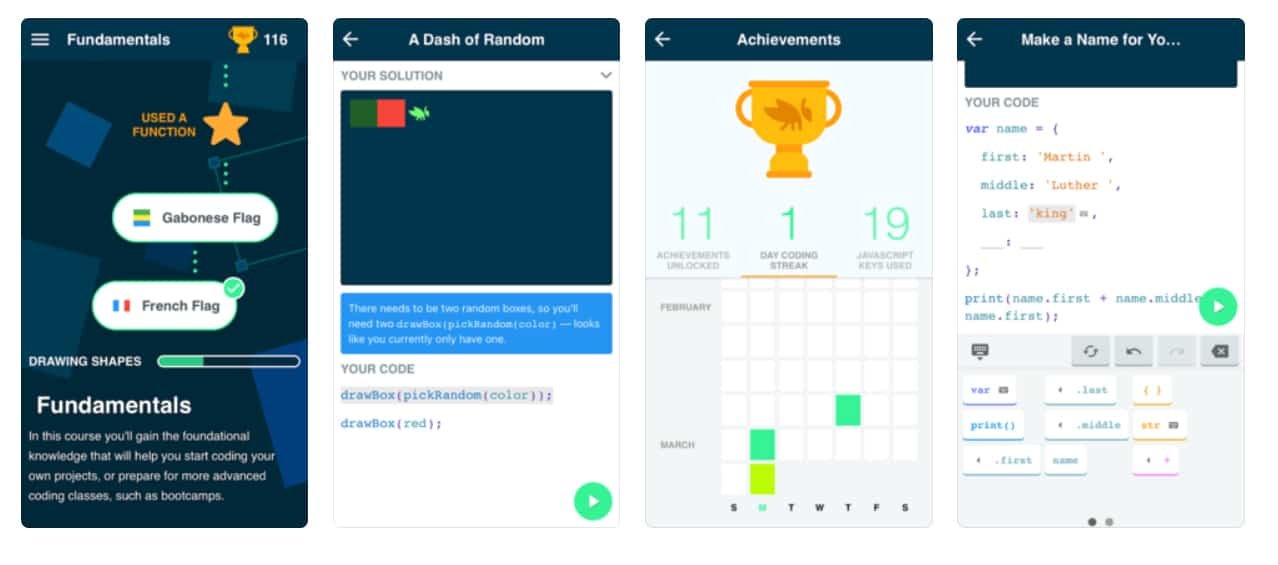
A bunch of Google employees participating in the company’s Area 120 internal incubator have launched Grasshopper, a free mobile app for Android and iOS that teaches you the basics of programming.

It’s beautifully designed and is suitable for just about anyone who can be trusted to use a phone on their own. By solving simple challenges and answering quiz questions, you’ll soon get the hang of basic JavaScript.

The gamified app, named after programming pioneer Grace Hopper, currently includes three sets of lessons, which cover the fundamentals of coding (calling functions, using variables and objects, and so on), as well as animations. The idea is to spend a few minutes a day with it, so you can have the app remind you to hop in daily and take on a few challenges.

When you’re done with the content in Grasshopper, you can move on to recommended Coursera classes to learn more about JavaScript, HTML, CSS, algorithms, and web design for a fee, or simply muck around in Grashopper’s online playground and make your own JS animations. Naturally, you can also explore alternatives for learning to code, such as the courses offered by edX and FreeCodeCamp.

I’ve been meaning to get back to coding for a while now, having ditched my chops when I graduated from high school. The app is fun and easy enough to get through a few challenges when you’re on a commute, and feels like a good alternative to scrolling through social media feeds mindlessly.

Grasshopper is the latest product to emerge from Area 120, which gives Google employees a chance to work full-time on their side projects and bring them to life. It’s previously seen launches like Uptime, which lets you watch YouTube videos in sync with friends elsewhere in the world, and Supersonic, a messaging app for emoji lovers.

thenextweb

This New Web Standard Could Finally Kill the Password

Passwords are pretty archaic. Unfortunately, despite the best efforts of companies including Google, Apple, Facebook and others, no one has figured out a uniform standard that would make it possible to do away with them entirely. Until, perhaps, now.

A new credential system proposed by the W3C—the World Wide Web Consortium—could be what we need to kill off the password for good.

Per the w3c, the new Web Authentication specification details an “API enabling the creation and use of strong, attested, scoped, public key-based credentials by web applications, for the purpose of strongly authenticating users.” In other words, this would be a universal system that could offer unique encryption keys for each user that could be accessed securely across every site, all in your standard web browser.

But the big upgrade is that, instead of being limited to a regular password, the API would also support the use of fingerprint readers, cameras, and USB keys as a method of logging into your account. In fact, some potential use cases even include using the fingerprint reader on your phone to log into a website that you’re browsing on your laptop or desktop, which may not have its own fingerprint sensor.

While the new standard is currently listed as just a “Candidate Recomendation,” the feature is already in use as an experimental technology in FireFox, with other browsers including Chrome and Edge expected to test the Web Authentication API later this year.

The sad part so far is that, despite input and contribution from companies such as Google, Microsoft, PayPal, Mozilla, Qualcomm and others, it doesn’t seem like Apple is on board to help test or refine the tech. That’s a real shame, because even though wide-scale adoption is still a ways out, it would be nice if there was a secure, non-proprietary login platform that all the big tech companies could agree on.

gizmodo

Yes Chrome is scanning your Windows PC, but it might be a bug

A few days ago Kelly Shortridge, a product manager at SecurityScorecard detected some unexpected behavior on her PC, as a honeypot Canarytoken reported being accessed by Chrome.exe. That’s not what you’d expect from a web browser normally, except for one thing — Google did add some antivirus-y capabilities to its browser on Windows late last year as an enhancement to its Chrome Cleanup tool that can help reset hijacked settings. Google Chrome security lead Justin Schuh explained how the feature works and pointed to some documentation about it, and that was that —

If you are hitting this issue and you want a fix right now then go to chrome://downloads in your browser, go to the menu in the top right, and select Clear All. That will clear Chrome’s list of downloaded files so that it won’t have any files to existence-check at startup. If you have a large list of downloaded files then this will improve startup time slightly.

It turns out the “AV scanning” wasn’t that at all, and what it was doing could affect you right now. It turns out that Chrome is checking the integrity of downloaded files at startup, and a bug lead it to that particular folder. It relies on the Downloaded History list for this check, and if you have a lot of files in there, it could slow down your computer when you start Chrome. While the dev team is working to skip the check entirely in a future update, users worried about it can fix it by clearing their download history.

Chrome Is Scanning Files on Your Computer

The browser you likely use to read this article scans practically all files on your Windows computer. And you probably had no idea until you read this. Don’t worry, you’re not the only one.

Last year, Google announced some upgrades to Chrome, by far the world’s most used browser—and the one security pros often recommend. The company promised to make internet surfing on Windows computers even “cleaner” and “safer ” adding what The Verge called “basic antivirus features.” What Google did was improve something called Chrome Cleanup Tool for Windows users, using software from cybersecurity and antivirus company ESET.

Tensions around the issue of digital privacy are understandably high following Facebook’s Cambridge Analytica scandal, but as far as we can tell there is no reason to worry here, and what Google is doing is above board.

In practice, Chome on Windows looks through your computer in search of malware that targets the Chrome browser itself using ESET’s antivirus engine. If it finds some suspected malware, it sends metadata of the file where the malware is stored, and some system information, to Google. Then, it asks you to for permission to remove the suspected malicious file. (You can opt-out of sending information to Google by deselecting the “Report details to Google” checkbox.)

A screenshot of the Chrome pop-up that appears if Chrome Cleanup Tool detects malware on your Windows computer.

A screenshot of the Chrome pop-up that appears if Chrome Cleanup Tool detects malware on your Windows computer.

Last week, Kelly Shortridge, who works at cybersecurity startup SecurityScorecard, noticed that Chrome was scanning files in the Documents folder of her Windows computer.

“In the current climate, it really shocked me that Google would so quietly roll out this feature without publicizing more detailed supporting documentation—even just to preemptively ease speculation,” Shortridge told me in an online chat. “Their intentions are clearly security-minded, but the lack of explicit consent and transparency seems to violate their own criteria of ‘user-friendly software’ that informs the policy for Chrome Cleanup [Tool].”

Her tweet got a lot of attention and caused other people in the infosec community—as well as average users such as me—to scratch their heads.

“Nobody likes surprises,” Haroon Meer, the founder at security consulting firm Thinkst, told me in an online chat. “When people fear a big brother, and tech behemoths going too far…a browser touching files it has no business to touch is going to set off alarm bells.”

Now, to be clear, this doesn’t mean Google can, for example, see photos you store on your windows machine. According to Google, the goal of Chrome Cleanup Tool is to make sure malware doesn’t mess up with Chrome on your computer by installing dangerous extensions, or putting ads where they’re not supposed to be.

As the head of Google Chrome security Justin Schuh explained on Twitter, the tool’s “sole purpose is to detect and remove unwanted software manipulating Chrome.” Moreover, he added, the tool only runs weekly, it only has normal user privileges (meaning it can’t go too deep into the system), is “sandboxed” (meaning its code is isolated from other programs), and users have to explicitly click on that box screenshotted above to remove the files and “cleanup.”

In other words, Chrome Cleanup Tool is less invasive than a regular “cloud” antivirus that scans your whole computer (including its more sensitive parts such as the kernel) and uploads some data to the antivirus company’s servers.

But as Johns Hopkins professor Matthew Green put it, most people “are just a little creeped out that Chrome started poking through their underwear drawer without asking.”

That’s the problem here: most users of an internet browser probably don’t expect it to scan and remove files on their computers.

When reached out for comment, a Google spokesperson redirected me to the blog post from last year and Schuh’s tweets.

A section in Chrome’s Privacy Whitepaper explains that “Chrome periodically scans your device to detect potentially unwanted software.” That exact language has been there since at least January of 2017, according to archived versions of the whitepaper. And similar language (“Chrome scans your computer periodically for the sole purpose of detecting potentially unwanted software”) has been there for even longer.

Martijn Grooten, the editor of Virus Bulletin and organizer of one of the premiere antivirus conferences in the world, told me in a Twitter chat that the behavior of the Chrome Cleanup Tool was “sensible.”

“For almost all users, this seems really harmless, and for those who are extremely concerned about Google seeing some metadata, maybe they shouldn’t be running Google’s browser in the first place,” he said.

Motherboard

Google shutting down goo.gl URL shortener next year

google shortener

The goo.gl link is very common on the web and was first launched by Google in 2009. However, the company announced on Friday, March 30, 2018, that it’s winding down the URL Shortener beginning next month, with a complete deprecation by next year. Fortunately, existing links will continue to work.

The URL shortener service launched in 2009 for FeedBurner and the Google Toolbar. With neither of those services available, the same is now happening to goo.gl for both consumers and developers. The latter group is being directed to Firebase Dynamic Links with the announcement meant to “refocus” Google’s efforts.

many popular URL shortening services have emerged and the ways people find content on the Internet have also changed dramatically, from primarily desktop webpages to apps, mobile devices, home assistants, and more.

However, for average users that just want to truncate a link, there is no new alternative from the company, with Google suggesting Bitly and Ow.ly.

Starting on April 13, 2018, new and anonymous users will no longer be able to reach the goo.gl console to create short links. However, existing users will have access to all features like creation, management, and analytics until March 30, 2019, when the console will be discontinued.

Google notes “all links will continue to redirect to the intended destination” even after 2019, with users also able to export link information from the console.

Developers are encouraged to switch over to Firebase Dynamic Links that have the advantage of automatically detecting the user’s platform and send the user to either the web or your app.

URL Shortener has been a great tool that we’re proud to have built. As we look towards the future, we’re excited about the possibilities of Firebase Dynamic Links, particularly when it comes to dynamic platform detection and links that survive the app installation process. We hope you are too!

9 to 5 Google